May 17, 2026
The world seems narrow.
I know the size and shape of every input and I slot them each into their time-worn synapses with horrifying absence of question or wonder. I am the ward of my former selves, marionetted by a trail of ghosts as I wander toward oblivion. There is no room in my periphery: the world slides away on either side. The thin quivering future is always, always and only directly in front of me.
But how did the expansive earth reduce to just this plank? On a cloudless night in the glance of stars I recall the absolute breadth of life. I see in bursts of starlight—and then the vision recedes. I carry its residue like a sliver of glass, burning and beloved, embedded in the very foot of my consciousness.
As I look out the window this morning, every surface is awash in sunlight, and I, like the air, might filter across any one of them and lead my shadow freely to cascade over staircases, sidewalks, gardens, the feet of strangers, any one of whom might smile. But I remain seated at the window. Something is not working. It occurs to me that somewhere I have made a mistake, miscalculated the area of possibility, misplaced the decimal, missed an angel’s instruction. It is as though something fundamental to me were curtailed; that my brief name were but murmured on the weightless tail of a shallow breath, its title unconferred and its charge unrecognized.
So I consider the fundamental: first steps, first words, placing block atop block, holding a crayon, and—finally—inevitably—I consider the counting from one to ten. Because to pass through a room you had to have entered it, and so on, forever. And the earliest instruments by which we order the world are among the first opportunities for error: so the child believes the path ahead to be no wider than its foot.
First, I counted on my fingers; I ordered the numbers as I oriented myself. Now so oriented, I fear they and I are fixed. It is as though—softly—a door has closed behind me, and left me at this window.
The width of the step is of enormous consequence. If I were to find that the first step is broader than I initially understood it to be, all subsequent steps may also be broader. The path that I have travelled will remain as it had always been, and the path ahead shall likewise be no different, but my sense may be completely altered and my experience fuller.
In truth, I see only hazily, though I strain to see. I stammer on about what I may or may not understand, hopeful to speak something the truth of which I will be immediately convinced. The number is its apparent self until I see something more in it—at which point, it and I are more.
By opening the words to which we are bound, we expand the acreage of our pen, uncovering the dimension of the life we share in it.
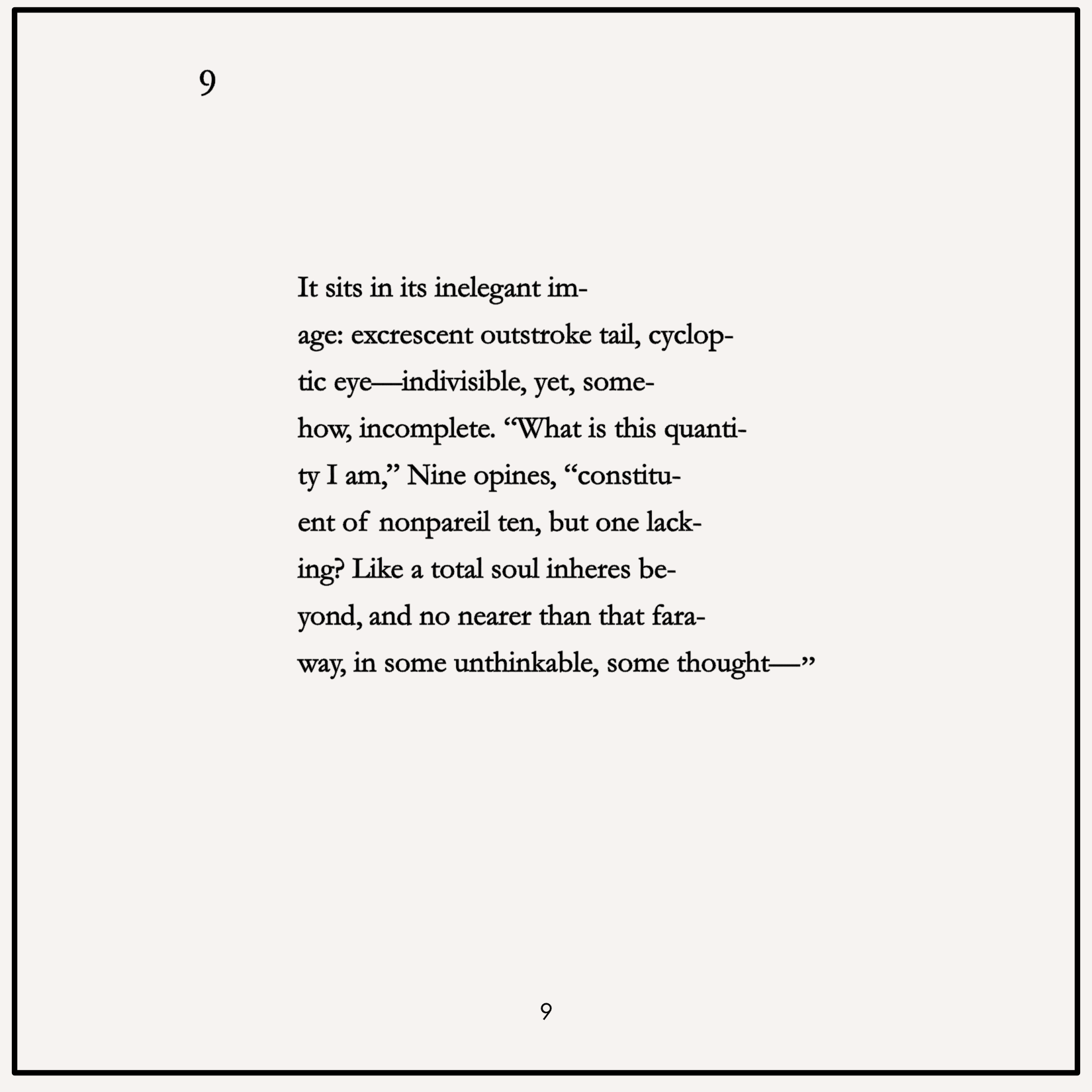
There is something reassuring in this: meaning that opens out from a small-seeming thing, an interior extending indefinitely beyond the surface by which it first appears. One could turn such a thing in their hands for a lifetime and never exhaust it. For the poem is an unfolding. It is a widened plane on which, for its diminished periphery, we may better focus; on which, for its better focus, we may apprehend greater detail. The poem does not enlarge the object itself; rather, it enlarges the attention brought to it. Like so, I am as 9's inelegant subject: bent to plumb its shallow bowl, yet gazing with all love and hope toward the ineffable X.





II. Petrarch's skull: Francesco Petrarca (1304–1374), Italian Renaissance poet whose Il Canzoniere explores themes of unrequited love, loss, absence, and spiritual striving. In 2004, analysis revealed that the skull in his tomb was not his.
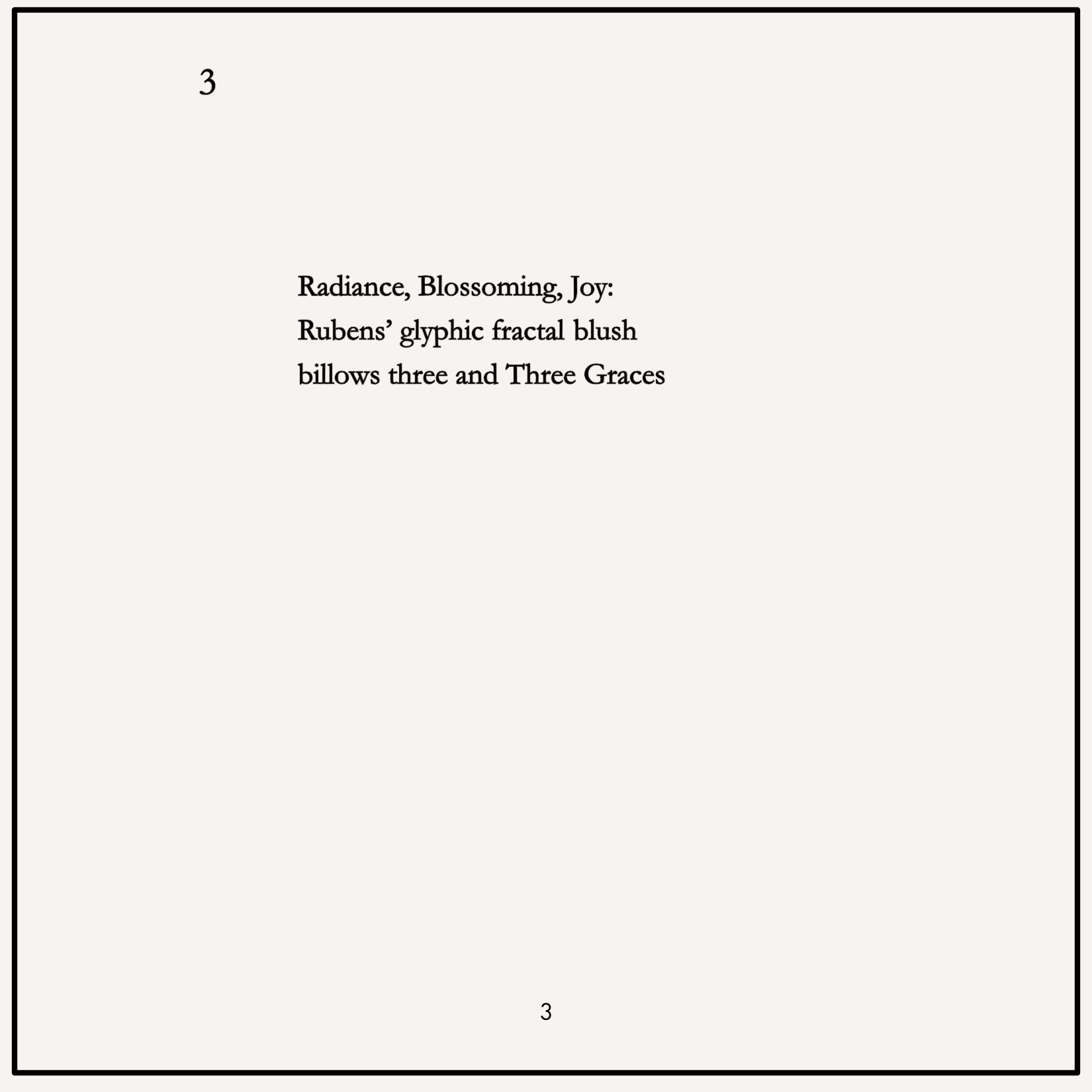
3. Rubens' blush: Peter Paul Rubens (1577–1640), Flemish Baroque painter whose vivid palette—particularly in the rendering of flesh—marks a major development in figure painting. The eponymous term “Rubenesque” commonly denotes voluptuous feminine beauty—a theme in his oeuvre. ⋄ Three Graces: Painting (1635) depicting the Charites (Graces), daughters of Zeus and Eurynome, personifying joy, splendour, and abundance.
IV. Tesseract: A four-dimensional hypercube that has extension beyond ordinary perception. ⋄ Tetragram: The Tetragrammaton is the four-letter Hebrew name of God (transliterated as YHWH in English). It is regarded as sacred and traditionally not spoken aloud. ⋄ nuclear mysteries: Nuclear Mysticism is a term coined by Salvador Dalí to describe his belief that modern physics reveal a deep spiritual structure. This is most vividly explored in his painting Crucifixion (Corpus Hypercubicus) (1954).
VI. a rose is a rose: Gertrude Stein (1874–1946), American modernist novelist, poet, and playwright, invoked the resonant power of insisting with difference, exemplified in the poem Sacred Emily (1913) in which the line “Rose is a rose is a rose” appears. Here as elsewhere, Stein’s poetics is a treatment of language as object, where words can be encountered in their immediacy rather than as vehicles for association. ⋄ a horse: Mister Ed (1961–1966), American sitcom featuring a talking horse, whose theme song begins with the tautological, near-Steinian line “A horse is a horse, of course, of course.”
VII. seven ... plague and salvation: Seven recurs throughout the Book of Revelation, enumerating symbols of divine judgment and redemption—among them seven angels, seven trumpets, seven plagues, and seven bowls. ⋄ woe: In the Book of Revelation, the three woes are escalating judgments that mark intensified suffering and the nearing of the apocalypse.
VIII. apocalypse: See VII. ⋄ ouroboros: Ancient symbol of a serpent or dragon devouring its own tail signifying infinity and the unity of beginning and end. ⋄ ampersand: A typographic ligature (&) derived from the Latin et meaning “and”.
X. syzygitic: Syzygy, an astronomical term for the alignment of three celestial bodies—typically the sun, earth, and moon—causing eclipse and intensifying tides. ⋄ Tetractys: A triangular figure of ten points arranged in four rows (1+2+3+4=10), revered in the Pythagorean tradition as a symbol of cosmic harmony and structure, the unity of number and geometry, and the divine mystery underlying all of nature. ⋄ laminar: Laminarity is a state of fluid flow in smooth, parallel layers with minimal disruption, such that a liquid may appear still despite continuous movement.